Thursday, December 13, 2012

December 13, 2012

Here's today's entry in volume two of my Occupy Journal:


o c c u p y : d e c e m b e r    12,   2 0 1 2


Publishing, which is what I know most about next to books and intellectual history, has never been mentioned in my two volumes and 300 pages about OCCUPY. When I decided to found a press and began publishing books (my first was 1953,then 1956, 1957, but I began full-time only in 1965),  publishing was already part of a superficial and increasingly gross world of Capitalism. In the 50 years since, it has disintegrated just like everything else, becoming more and more commercial, commodified, and more and more divorced from the lives and needs of ordinary people.  Like all the arts, it is just another entertainment industry, dumbed down and bottom-lined.
     I'd like to look, first, at the language publishers (that is, editors) use, when they talk about their profession.  Publishers Weekly interviewed eleven publishers, editors, authors, and agents about African-American publishing and quoted those interviewed in their December 10, 2012 issue which arrived today. Eleven different firms were represented, a cross-section of this commercial world.
     Here are some of the ways these professionals refer to that world:
"issue-driven books;" biting off big ideas;" shortlisted;" "writer-platforms;" "debut novel;" "debut Haitian authors;" "projects" [that is, books]; "the celebrity books was big;" "reality TV;" "romantica" [by which she means the combination of romance and erotica, or, as she says, "steamy romance with erotica"]; "what used to work is not working anymore;" "hot categories;" "chick/lit sisterfriends;" "sexy stuff;" "Vampire-Huntress series." Listen to these people. These are African-American highly educated, serious professionals, in a world of millions of Black men in prison (The New Jim Crow world), hunger, disease, war. It's the same in whitey land of course. Here's some more of this twenty-first century literary sensibility: "Any trend that's hot eventually levels out;" "how to position [books];" "strategize;"
"pull together talent;" "teen lit;" "street lit;" "what will sell;"
"We don't publish Toni Morrison here;" "teen fiction rising star;"
"sun rights sale;" "book-a-year authors;" "I acquire middle-grade fiction;" "go-to figures;" "Christian fiction;" "commercial women's fiction;" "waves and trends;" "breakout books;" "top 100 authors."


Yes, there were one or two sentences in three pages that reflected something approaching idealism, but you get the picture. Literature this is not. It's the same in all the arts, when professional parasites get hold of us.
     Forever, artists, authors, creative talented people in every century have been taken for granted and treated to the kind of commercialism and philistinism that is represented by the language the publishers and editors and agents use. Topicality, celebrity worship, searching for what they call "blockbusters." I would say such people are no more reliable than the politicians and leaders they select, and we know that less than 10% of the public trust those. Who in the world of commerce today is trusted? Why should be trust any of them? Those of you who work in the Business World know first-hand the lying and stealing, the short cuts and shoddiness that goes on in your firm; why should it be any different elsewhere in america? Or the Western World in general? Meanwhile, the West has so fucked up the rest of the world, there is only violence and reaction to Western so-called "cultural norms." These "cultural norms" are not normal; they're toxic and disgusting, anti-human and alienating. How can so many people work against people? Do they think they are immune? It's like the period of forthcoming nuclear war, when the welthy built underground shelters and the politicians incited nuclear holocaust. Did they think they would survive? And survive in what kind of world? We need a strike. A world-wide strike of people. Just saying, "We won't do it any more." What's the ":it?" All of it.
     I think I'll make a sign right now and put it up in the bookshop, or wear it around my neck. It will simply say, "ALL OF IT."

Monday, December 10, 2012

December 10, 2012


How you think is almost as important as what you think. When I write poetry, I warm up by reading . . . Plato. It reminds me of my brother-in-law, Morris. Morris is an engineer. And he loves to work on cars. But he hates to get his hands dirty (he takes three showers a day, every day).
He solves this dilemma as follows: when he goes into his garage to work on a car engine, first thing he does is dunk his hands. up to the elbows, in a bucket of crankcase oil.  Now Morris is ready to work on cars! Plato is my crankcase oil for poetry.
     For prose, for the journals especially (for I wrote a novel along with the ten journals in 2012), I read the most dense, scholarly essay I can find. I read it and think about it, usually tear it apart in my mind. That's how I warm up for the journals.
     This morning I'm reading an essay by a psychologist. A feminist psychologist. So here's what I think about psychologists and about feminist psychologists.
     When the few women who were psychologists found Woman's Liberation exploding around their ears in the 1960s, they saw a great chance to advance in their profession. They began to develope a feminist psychology. But it was the same problem as happened in feminist art and feminist everything. The landlords were all men.  The heads of departments were all men, all the Deans, all the Chancellors, all the grant-givers, all the tenure-givers, all the donors whose names adorned the library and the Psychology Building, all the psychologists, all men! All men. All the editors of all the psych journals.
     So, little by little the feminist psychologists became claiming their piece of the pie.
     It's like Ed Whitfield said one day in our Tuesday morning "Democracy Char" that F4DC began years ago. Ed told us, "They say if they give you a fish, you eat for a day. But if they teach you how to fish–or rather, if you go into debt in college and learn how to fish–you'll eat forever. What they don't tell you is they own all the fishing holes."
     And another thing. Lucy Lippard, the first and best feminist art critic, says "We wanted a piece of the pie. But the pie was poisonous." Because women artists ran into the same problem women psychologists were running into. The Museums and the Art Galleries were all run by men, or by women playing by the men's rules. So the artists and psychologists and the fisherwomen, too, I guess, began slowly pecking away at the pecking order. Entering into the patriarchal hierarchy.
     And they were successful, at least the over-educated white women were. But it was still a hierarchy. Only they were in the middle of the muddle, not at the butt-end anymore.
     The rules stayed the same. That was the problem as the '60s and 70's became the '80s and '90s. Women psychologists thought they would be the ones to redefine gender in feminist terms. But every time they tried to bring politics or society or values or history into the equation, they got flummoxed and stymied. The male rules of Academia allowed no mention of Native American Indian genocide nor no Native Americans, no mention of Slavery nor African Americans. So the women, to get ahead, played the game within the confines of the Academic/Military/Industrial/Captalist Complex.J. G. Morawski concludes, for example:

The study of gender remains embedded in conventional interpretive frameworks that view human action as corresponding to some stable, identifiable, and internal state thqt is to some extent unalterable by some of the same dilemmas that feminists faced earlier in the century . . .
     Thus is explained the entire intellectual history of Feminism in our time. It began creatively and dynamically. Then it began to be institutionalized, as everything is in Capitalism, for gain. As ideas become institutionaized they lose their elasticity and become moribund, as did feminist activism. Of course, no one blames themselves; everyone justifies. So when feminism became too hard to sustain and activists got tired out, they said it’s the backlash, we’d still be commited to social justice but for the big bad backlash. Academia is especially good, shallow ground for the grounding of high fliers. Moreover, the roosters still ruled the roost, although the hens were getting a few bucks and caps and gowns now for laying eggs. What was needed in Art as in Psychology, in the Sciences as in the workplace, was a feminist politics, a feminist value system, a feminist society, the inclusion of people of color, immigrants, and different sexual preferences. Gender and Sex itself had to be newly defined and deconstructed. The fishing holes had to be occupied. 

As you know, two blogs ago I began selecting new entries from my ten journals to include in my blogs, hoefully with lots of illustrations. What I'm most interested in the past couple of days is Sex & Gender (excerpts from my Sex Journal). There's a collection in the bookshop called Sex & Gender, a couple of dozen essays, neither terribly interesting or terribly boring--but provocative. That's what I've been riffing off these first three blogs (December 8-9-10). But now, I've got a treat for you, although it will take some tough love and tough mindfulness. bell hooks. A book came in today, by bell hooks, Yearning: Race, Gender, and Cultural Politics (Boston: South End Press, 1990). I'm reading the chapter entitled, "Reflections on Race and Sex," pages 57--64.
     But, first, I have a story for you, first published in my "Bookshop Journal." Kind of about bell hooks. Really about Chelsea, but every time Chelsea came into the bookshop, she bought a book by bell hooks.
     One day she came in with her father. It was a Sunday and only a few hours before, ol' Chels had graduated from . . . Guilford College! (I've never met a Guilford College student, and I've met dozens and dozens, that didn't love Guilford.) Yep, the Graduation Ceremony had just taken place, and Chelsea was feelin' good! Her Dad is a rich doctor from Cambridge, Massachusetts. Costs a pretty penny to go to good old Guilford.
     They browsed through the books, there's some 5,000 in the store, hundreds of strong feminist Women and Gender Studies for Chelsea to pour through. Not so many 50-cent novels for the Dad. But he found something, came up to the cash register to pay, grabbed Chelsea's book out of her hands, and triumphantly handed them to me as if to say, "I'll -- take -- care -- of -- all -- this!"
Big smile, full wallet.
     That'll be 50 cents for your book, sir," I said, "and $35 for the bell hooks."
     "What!!!" The doctor began thumbing through the rather slender bell hook collection of essays, as if to discover why it was so expensive. He read the Table of Contents.
     "It's only a paperback!" he complained.
     "Yes, but published by Routledge in London. They're the most expensive Woman and Gender publisher in the world." 
     Dr. Man siddled up to his daughter. Remember, now, she had just graduated from college that morning. She was standing there like a statue, as if she wasn't even in the room. He whispered to her, so I wouldn't hear, "You''ll pay half?" Chelsea nodded her head, looking straight ahead.
     All smiles again! Doctor Dad back to the register. Here comes  the black wallet. Paid for everything. Last of the Big Spenders. And they left. As she walked out the door, Chelsea finally came to life. Looking sharply at me, she hissed, "It's bell hooks on sex, Al!" she said.
     
So here comes bell hooks.


She begins by saying that the bodies of Black women were the "playing fields" where racism and sexuality converged. "Rape as both rite and right." Rape, too, was what the White Man from America and Europe were doing to Africa and the "colonial" world.
     As for gender, providing a metaphor for colonization. Domination. Served to remind the oppressed who they were, and they couldn't do anything about it! "Fucked and fucked over by the dominating victorious male group."
     bell hooks says there is no adequate history of what the white man did to black women, no "psychosexual" history. Sexual voyeurism. Even if a white man got romantically involved with his black slave, he was simply declared insane. Couldn't upset the dominant paradigm of oppression. Instead of a true story, she explains, the white man invented a lie, that black men were after their pure white women, to violate those bodies. Revenge the motive.The sexual metaphors have been accepted, she feels, political domination equated with sexual domination. She reminds us of Eldridge Cleaver claiming that raping black women he did was merely practice for the eventual raping white women (Soul on Ice), "to redeem my conquered manhood."
     Sexual exploitation of black women was used by slave-owning whites to dominate and humiliate white women, phallocentric dominance within the family. Freedom = manhood for both black and white men. Men bond across class, race, and nationality, using rape. Does male commitment to maintaining patriarchy erase difference?
     Racism and sexism are interlocking systems of domination,
upholding, sustaining one another.


     bell hooks can't see any separation between racism and sexism. But she fears white women see spending time on racism as taking time from sexism. Yet they are interlocked! Yet this separation supports the belief that black males wish to use sexuality to assert
dominance and manhood. Not good.
     ""The stereotype that all black men are rapists is re-inscribed and reinforced." Yet statistically, men rape women of the same color as themselves. Black male lust--white woman sexuality . . . popular in music videos. The real issue is white supremacy as genocide. The media motive for perpetuating the lies is political of course. Black women are not listened to when theuy condemn black male sexism; instead, they are seen as "bashing" black males. Raciscm and sexism are interlocking forms of dominance. The whole society is racist/sexist. All women's bodies are devalued, but black bodies hold less value than white. She sees why young, black men are nihilistic and despairing. Not valuing their own lives, how can they value the lives of others? Black people, particularly black men, are just scapegoats.
     We must engage in anti-racist, anti-sexist work.  New identities have to be built. Malesness is not Black Liberation. There is a collective plight. There is no degree of difference in a black man harming a black woman or a black man harming a white woman.. It is the same harm, it is not racism.
     bell hooks is a critic of quick judgements on black authors by white women in the women and gender field. She feels there is a superficial judgement being enacted in the name of boycotting misogyny and sexism; she devlopes this theme in another essay,  "Feminism and Black Masculinity," but we will say s'long to bell hooks for today, and move on..


December 9, 2012

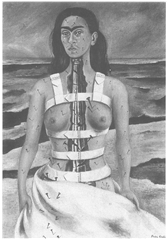
Frida Kahlo (1907-1954), "Broken Column" (1944)

As I approach age 77, I have begun to think of myself as an amateur intellectual historian. This year, I have written ten (10) journals, ranging in size from 120150 pages each. They have titles like "Bookshop Journal," "Bike Journal," "Publishing Journal" "Occupy Journal," "The Co-op Journal," "Woman's Journal," "Spiritual Journal." My latest is "Sex Journal."
     As an intellectual historian, one of my greatest interests, perhaps the greatest after peace-and-justice, has been Feminist Art. Perhaps the most famous feminist artist of all time, next to Georgia O'Keefe of course, is Frida Kahlo. Yet I have never "investigated" ("studied," "thought of") her as a feminist artist. This morning (and it really is morning: 4 a.m.) I'm asking, "What is particularly feminist about Frida Kahlo?" To help me answer that question, I've read

Liza Blakewell's "Frida Kahlo: A Contemporary Feminist Reading," in Frontiers, A Journal of Woman's Studies.
     
I spent a year in Mexico (1959), where I had gone to put together an Anthology of Contemporary Mexican Poetry for my new poetry press.And I agree with Liza Blakewell that Frida must be understood in the background of mestizaje, whose most visible figure was Jose Vasconcelos and his "raza cosmica." It must also be remembered that her father, Wilhelm Kahlo, was a Hungarian Jew who emigrated to Mexico in 1892; Frida was Mexican, but she, like Mexico itself, was a hybrid of Europe.
     In 1929, Frida married the most visible artist of mestizaje and the new revolutionary self-conscious nationalism and indigenista of his country, Diego Rivera. When I took classes at The New School in New York, the entire dining room was covered with original murals of Orozco, so one can see Frida's background, in part, in the Mexican mural genre; however, there were no women muralists.

In my "Woman's Journal," I disclose an unusual feature of gender difference between men and women in the workplace that has great relevance for seeing Frida as a feminist I realize. In the workplace, when there is conflict and problem, men are able to resolve and reconcile half the time; they do this quickly, if not well. Women, on the other hand, are able to resolve and reconcile less than half as often as men, and they do so slowly. The feminist study in which I read this report explained that, for me, the question was how to "get on with the job" as quickly and efficiently as possible, even if it meant a less than sincere overlooking the problems. But for women, the relationships were more important than the job, and they wanted problems between people looked into deeply and well. 
     How does this apply to Frida? Well, the Mexican Revolution that her husband was the artistic leader of had immense contradictions and betrayals, huge problems, problems that resulted in the October 2, 1968 government massacre of hundreds of peaceful citizen protesters in Mexico City for example. For Diego Rivera and the other male artists, these contradictions were quickly glossed over. But for Frida, the Mexican Revolution included its contradictions, and she refused to gloss over them because they highlighted relationships interesting to her as a woman and an artist, or so I think. Bakewell even sees Frida combining male and female within individuals in her art, as she embraced everything puzzling and problematic, a great feminist characteristic (at least, one outside of Academia). Frida was a cultural cross-dresser!

     Frida was also a social cross-dresser and cross-dressed in her paintings. She posed for a photograph, with her family, dressed as a man, as a protest of "woman's place." She paints herself in male clothing of her time and place. She cut off her hair (a protest against "female beauty"). She would paint a moustache on her self-portraits and exaggerate manish facial hairs, gender-blending and sexually ambiguous to say the least. Mexican women were repeatedly told to stay out of the political realm, but Frida continuously violated this spoken and unspoken prohibition. 

     Finally, Frida fashioned a feminist identity for herself, ingeniously and originally. In Mexico of her time, a woman could gain recognition in mainly three ways: in religion, on the stage, and in her marriage. Well, Friday married well, from the point of view of recognition (Diego Rivera). And her home, her life, and her paintings are replete with religious iconography. Although she did not do a lot of stage, she did do a lot of staging, as she was primarily a self-portraitist of what today would be called "the Cindry Sherman kind," of so I believe. Finally, as Octavio Paz has pointed out, Frida was feminist by virtue of her deliberate sexual ambiguity, an original protest in that place at that time.


Sunday, December 9, 2012

December 8, 2012

What used to be called masculinity/femininity (a hyphenated bipolar dimension now usually viewed as two orthogonal dimensions) have been reconceptualize.                                                                                   Philip Savoer and Clyde Hendrick, Sex and Gender (Sage Publications, 1987), p. 7

That "orthogonal" might stump you. But ortho- is Greek for "straight" or  "correct"; and -gonal simply means "angle."
The authors, editors of a collection of essays, are simply saying that it ain't just male-female anymore; it's gotten more complicated. But only because Sex was too narrowly defined before. Before what? Before The Woman's Movement.
      The Woman's Movement has brought us so much. So much more than anyone, including the women themselves, knew they were bringing, when the Second-Wave-Feminism struck the patriarchal shore in the last years of the turbulent '60s.
     Not only sex and gender have changed of course. Everything has changed. And changed for the better. And it's still changing. And if the world is to be saved, The Woman's Movement will save it.  

I'd like to be able to speak of the nature versus nurture debate in my journal. So let's unpack the term, make sure we know what it means. The debate only began a hundred or so years ago, but the nurture part of the equation comes from the tabula rosa of John Locke and refers to one's environment; Locke philosophized that a person is born with a blank slate on which her environment writes. But after Darwin (1848), nature entered, and you have a debate. Nature of course are our inherited characteristics . . . built into our cells. Pre-environment. In fact, a relative of Darwin, Francis Galton, is given credit for the phrase "nature versus nurture debate," in the late 19th Century. Agency versus structure (socialization versus individual autonomy is how Wikipedia puts it) is another way of saying the same thing, but more contemporary.
It's the most interesting question, isn't it? Why do we behave the way we do? Is it biological? Is all behavior a social construction? I said to my friend, Charlie, yesterday, "Even sex is a social construct," and he immediately replied, "What about biology?" Many feminists believe that biology is raised as a male sword to sever social constructionism. They ask sarcastically, "Are you saying woman's natural place is in the kitchen?"


     It's the most interesting question, isn't it? Why do we behave the way we do? Is it biological? Is all behavior a social construction? I said to my friend, Charlie, yesterday, "Even sex is a social construct," and he immediately replied, "What about biology?" Many feminists believe that biology is raised as a male sword to sever social constructionism. They ask sarcastically, "Are you saying woman's natural place is in the kitchen?"
     But what about violence? Male psychologists believe that men are six times more likely to commit murder than females. And as they study other mammals, they find the male almost always seems more violent than the female.
     What of the effect of testosterone, which females don't have?
     Some feminists, who generally favor nurture over nature of coure, like Carol Gilligan, opt for a combination, an interaction of genetic and environmental causation; but no one has found the link between the two, if they do interact. And, yet, to consider environment and genetic entirelty separately is counter-intuitive. I'd like to dig more deeply into gene-environment interaction, as it's a new and important field, and its impact is felt in every branch of Science and the Humanities.


What's most fascinating to me, but I haven't read the literature, only made observations in the garden, is what is known as sociobiology, that is, that is that principles of natural selection apply to behavior as well as physicality. Natural selection is Darwin's theory of evolution: (1) inherited variations within species; (2) competition and survival of the fittest;
(3) natural selection results with better adaptation to the environment. Behavorial tendencies are assumed to be inherited. My cat, Glenwood, told me this.

     In mammals, Parental investment theory is the observation that males can have many offspring; women are usually limited to one a year. The Ugandan kob may be an extreme case, but these antelopes are usually used to prove that males are phsycially different from females for a reason.
     A lesser known theory of Darwin's is sexual selection. For example, if the male can spread his seed around and have many offspring, but the female must invest an entire year to a single offspring--a year and quite an expenditure of physical capital--then it behooves the female to be very selective in her choice of mate, in the genes she'll be tending for so long and at such expense. Hence, says Darwin, the competition between males, to demonstrate to the female that theirs is the greatest, wisest choice of mating material. Because this can be seen as a female exerting behavior upon the males, Darwin called it "sexual selection."


My pussycat, Glenwood, has never met another cat. He was found in a cellar, about a week after he was born, no sign of his mother. No
siblings. Joseph rescued him and gave him to me to look after while he went to Florida. When he came back a week later, I wouldn't give
Glenwood back to him. (We had a Facebook contest to name him, and we both live in the "Glenwood" section of Greensboro, N. C.) Yet Glenwood exhibits almost every behavior of any cat I have ever had. (He doesn't purr.)
     Humans exhibit many characteristics of our mammalian forebears. Yet there is a myriad of behaviors that no other species exhibits, certainly in our male-female, female-female male-male relations. (I am pretty ignorant about most but all aspects of Transgender.)
     "Glenwood" says he has absolutely no interest in sugar. Sensitivity to sugar is extremely rare in carnivorous animals.
     Scientists are fond of comparing giraffes and monkeys. They think there's a reason the monkey doesn't want a  l o n g  neck.

I'm going to have to do a lot more research on animal-human morphology before I reach any conclusions. So far, I only see men doing the research and reaching conclusions that seem very male-centered to me. I'd like to see up-to-date research, as mine stops before 1990. For example, here is the conclusion Douglas T. Kendrick reaches in "Gender, Genes, and Social Environment," but I would have to question every word in it, although I don't doubt it represented scientific knowledge of 1986, when he wrote it:
     "When we consider learning biases, the general map is provided by the genes; but the specific stimulus topography is provided by experience. Similarly, genes code for the development of certain structural features, but the effects of those features will depend on life experiences. Life experiences also have a reciprocal effect on the biological organism resulting in chronic alterations in biochemistry."


  I


Thursday, September 27, 2012

September 27, 2012

http://pauldlavack.blogspot.com/ 
is the blog of my friend, Paul. and I recommend it to you.
He and I are members of the Employment Working Group (w.g.) of Occupy Greensboro (OGSO).
Paul got a great idea for how to gain employment for ex-convicts, who are the hardest to get jobs for of any population in Guilford County (N.C.). We're going to meet with a group of ex-cons next week at the Interactive Resource Center (a day care center for people who are homeless), and ask them to critique Paul's idea, so I won't say any more about it, until they do.

I just wanted to bring you all up to date on my happenings. They have to do primarily with the journals I am writing: Bookshop Journal, Occupy Journal, and Publishing Journal have recently been completed and printed. Almost completed is Gardening Journal and The Nice Journal. Halfway done are Co-Op Journal and Spiritual Journal. All these journals run around 150 pages. Recently begun and only on page 25 are the two new ones, Woman's Journal and Occupy: The Second Year.

My other major activities are of course Glenwood Coffee and Books and Unicorn Press, Inc. Both have websites now, so I hope you'll check those out. I still do as much as ever within The Occupy Movement. Tuesday mornings are "Democracy Chats," created by Fund for Democratic Communities (F4DC). I'm active in The Energy Working Group of OGSO. I'm supervising a mess of students from UNC-G and Guilford College, who intern at OGSO and at Unicorn. Recently joined Elsewhere Gallery. Director of The Weatherspoon Museum and her curator, Elaine Gustafson, are visiting the bookshop tomorrow morning.
     My good friend, Jacque David--and Bob--just had a baby, Penelope. I had two other friends over and served them pizza in my new pizza oven: Daniel and Lauren Goans.
     My Unitarian Fellowship meets in the bookshop now. Sunday we'll be serving block party breakfast to everyone in Glenwood. And "Glenwood" the pussycat says hello.
     That looks like an entire Lake Woebegone update for now. Sorry I've been neglecting this blog, because of all the writing in my journals. For example, just completed 25,000 wordson Walter Benjamin for Spiritual Journal.
     Participatory Budgeting is a new interest. Bib meeting on Ground Rules for organizing PB being held in the bookshop next week . . .
     That's enough for now . . . Don't forget Paul's blog . . .